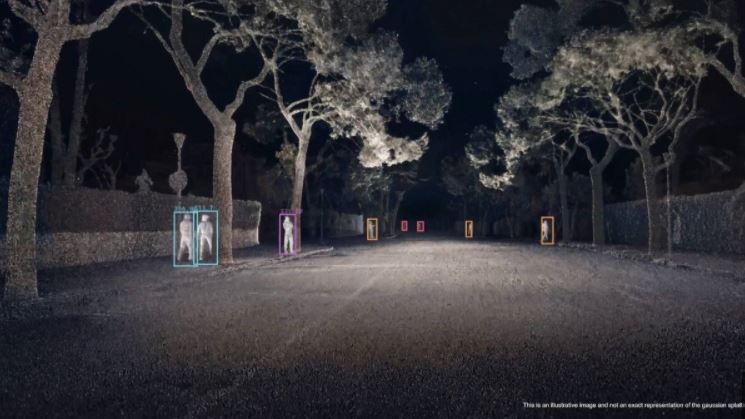
Volvo Cars is using AI-generated life-like virtual worlds to enhance the development of its safety software, such as driver assistance systems (ADAS), all with the aim of creating even safer cars.
We can now synthesise incident data collected by the advanced sensors in our new cars, such as emergency braking, sharp steering or manual intervention. This allows us to probe, reconstruct and explore them in new ways to better understand how incidents can be avoided.
This is possible thanks to an advanced computational technique called Gaussian splatting, which can create a vast amount of realistic, high fidelity 3D scenes and subjects from real world visuals. The virtual environment can for example be manipulated by adding or removing road users and changing the behaviour of traffic or obstacles on the road – to generate different outcomes.
Such a technique allows us to expose our safety software to all types of traffic situations, at a speed and scale not possible before. We now can develop software that works well also in complex, rare yet potentially dangerous ‘edge cases’ and reduce the time it takes to expose our software to edge cases, from months to days.
“We already have millions of data points of moments that never happened that we use to develop our software” says Alwin Bakkenes, Head of Global Software Engineering at Volvo Cars. “Thanks to Gaussian splatting we can select one of the rare corner cases and explode it into thousands of new variations of the scenario to train and validate our models against. This has the potential to unlock a scale that we’ve never had before and even to catch edge cases before they happen in the real world.”